Updated 12/15/2008: This post was written last year, but I didn’t have enough photo of Lao traditional wedding to make it fully complete. I attended a Lao traditional wedding in Paksan Laos on November 8, 2008, and had an opportunity to take some photos of the wedding. Please note that the groom in this wedding did not wear a Lao Traditional outfit described in this post.

Courting, Love, Marriage. If you’re Laotian what better way to assure a lifetime of love and marriage than a Lao traditional wedding ceremony. It’s considered to be one of the most honorable duties for Lao girls, and most joyful for her parents to see their daughter honoring and respecting them by choosing Lao traditional wedding as a median in transition of starting a family. It might not legally be recognized as a marriage but more so of a tradition. This is to value the Lao ways, respect Lao culture, and respect our elders. The couple can make it official at a city hall prior or after the Lao traditional wedding. Some might also have a Christian ceremony in conjunction with Lao traditional wedding, which is also acceptable and at the same time, legally recognized.
The Lao traditional wedding ceremony has been around for generations and very important for younger generations to pass down, if not like anything else, the Lao tradition will die out. The marriage is taken seriously by the Lao community and all parties involved, and it’s regarded as a lifelong commitment made by the couple. In the eyes of the Buddhist religion, the marriage is recognized and sacred, but the wedding ceremony need not be conducted in the presence of monks and is usually performed at the bride’s home.
We’ve heard of the Buddhist wedding ceremony which made us to believe that the monk would perform the ceremony, but in reality the monk doesn’t perform the Lao wedding ceremony, and if the monks were present at the Lao traditional wedding, they are not directly involved but more so as to Tum Boun Tak Badth (blessing and morning Alms); if they’re invited, Ni Mon, which we’ve often seen at a Lao traditional wedding, there always should be an odd number such as 3, 5, 7 and the maximum could be 9 monks for good luck.
The Lao traditional marriage involves a tradition called Sinsord, which is a custom of paying a dowry to compensate a family of the bride for her mother’s milk or Nam Nomb. There’s no set amount, the sum is typically determined by the bride’s family, which they might ask for the amount that is determined by the status of the bride’s family, that can vary from money, gold, live stocks, land, etc. Nowadays, only some families hand the dowry back to the couple as a wedding gift, some families in the US don’t require a dowry, and some families keep the money.

There’s much excitement in the air on the day of the wedding, if back in Laos, the groom, accompanied by friends and family would Haih Khun Maak, a parade from his house to the bride’s home, in a very festive manner with singing and dancing along the way. It’s not as convenient to do so in the US, but to mimic back home, often times, the grooms side would gather near the bride’s home and Haih Khun Maak, this then starts the noble event of the Lao traditional wedding.

Eagerly awaiting on the brides side, they could see Haih Khun Maak, leading the group is the groom who is dressed in his Lao traditional outfit, he has on a white or crème silk top with blue and white checkered pattern ceremonial sash, and a silky sheet which is folded into traditional pant style. He carries a bouquet of flowers and lit candle, and someone would help to carry an umbrella over his head, oftentimes it’s his best friend or the best man. The respectable elders or parents would carry Khun Maak with dowry inside, and the rest of the party would carry gifts for the bride. Everyone seems so happy, so much joy in the air that you can hear the Haih Khun Maak song and see the people dancing as they’re approaching.

As Haih Khun Maak is approaching, there’s a lot of nervousness and excitement for the bride, she has to stay in her room until being called out to join the ceremony. There’s no denying that she is the luckiest and the most beautiful girl at the moment. Her costume is made of beautiful colors and sophisticated patterns, silk top, ceremonial sash, and sinh (a traditional skirt/tubular skirt). Her hair is tied up into a bun and decorated with traditional style jewelry. At that moment, the wait seems like an eternity.
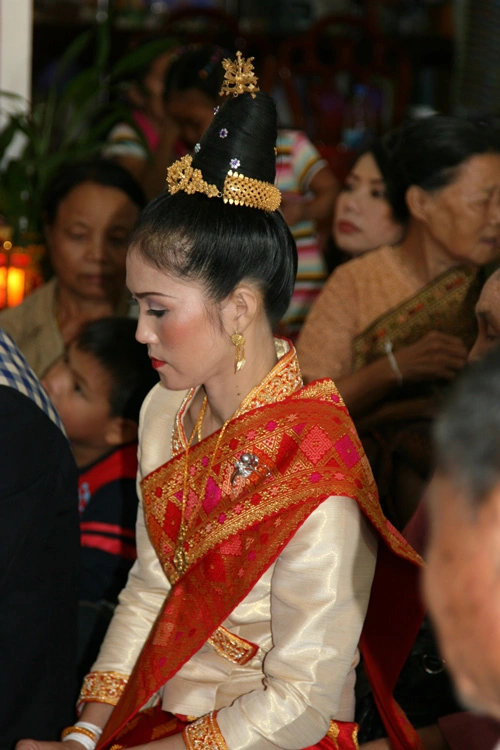

When Haih Khun Maak approach the front door, there would be a gate by the front door, the gate is made out of a Lao traditional style belt with vintage Lao graphic designs made out of silver, gold or nark, held at each end to block the front door, to prevent the groom from entering. In order for the groom to pass this gate, he has to answer several rhetorical questions, as if they’ve never met before, questions such as ‘Who are you? Who are your parents? Why have you come here? Are you here in good terms and will you be nice to us?’ and there might be more just to spice up the events. The groom then politely answers all questions to show respect, and if the bride’s friends and family are happy with his answers, he then has to pay money to enter the gate, similar to tipping the gatekeepers, which often are children or young Lao girls.


Once entering the front door, he is then greeted by a respectable elder that has had a long, successful marriage and a role model for the community to take him to his place at the two Phakhuanes, which are used for a wedding ceremonies called Sou Khuane. The two Phakhuanes are made from fresh banana leaves (can use green decorated color paper to substitute), cut and folded into cone shape, and decorated with fresh flowers, silk flowers, or plastic flowers. The bride, both sitting in front of the two Phakhuanes, then joins him then the wedding ceremony of Sou Khuane begins.

The Lao traditional wedding ceremony begins with Mor Phon, a person that performs the wedding ceremony, he would take the white thread that’s connecting the two Phakhuane, and give one end to the groom and the other to the bride while holding it in the palm of their hands in a Wai position, which is the upside down Y shape.

Mor Phon then closes his eyes and begins the ceremony of Sou Khuane by citing chant verses, very poetic in nature, advising the bride of what is expected in a good wife, and the groom of his role as a good husband. The duration varies, it could be anywhere from 30 minutes to 1 hour, and at the closing of the ceremony, the crown of families and friends join in and say, “Khuane Aeh Ma Deh”, meaning “please come, spirit come.”

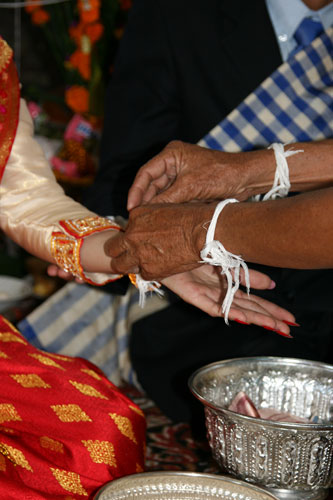
Mor Phon then does the honor of tying the white blessing stings on the couple’s wrists called Phook Ken, after he finishes, then everyone joins in to tie the couple’s wrists and whilst doing so, they would also give blessing to the couple. Some people would roll up money and tie it on the white string, to give as a gift for the couple to start their lives together. The symbolic of sting tying is for good luck and a blessing to the couple, two spirits joining as one is a big transition for both bride and groom, and this closes the Lao wedding ceremony of Sou Khuane, the couple then joyfully start their new lives together.

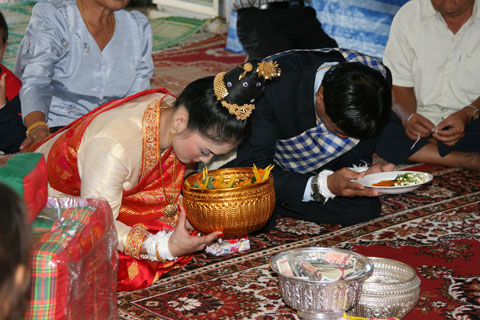


The Lao traditional wedding ceremony comes to a closing, but not necessarily the fun, festive, and big celebration. Oftentimes, the festive celebration takes place that night where there would be a live band, food, and dancing. The bride and groom are the first to dance on the dance floor, often in the style of Lamvong where the couple would dance in a Lao traditional style to open the dance floor. After their first dance, the couple would then Wai the audience as an invitation to all, and then the dance floor is open to everyone.


 Nye Noonaz
[…] “Courting, Love, Marriage. If you are Laotian what better way to assure a lifetime of love and marriage than a Lao traditional wedding ceremony… ” (read full post here) […]
Cheers Nye
We’re off in two weeks time. We’ve managed to get a wedding organised at Luang Prabang. Margaret is busy making a copy of a traditional dress out of some silk we got from Thailand some time ago. It’s all good.
I’ll post up some pics when we get back
ross
Hi ross, thanks for keeping me posted. I wish you and Margaret lots of luck and have a safe trip. 🙂
Although I’ve never attended a traditional Lao wedding, I’ve been to a few western-style weddings involving Lao couples. In every case, I (and my guest) had a great time. Traditional elements were incorporated into the ceremonies, and sometimes a couple would have two weddings on the same day – one traditional (with close family members) and one modern (with both family and friends). I remember being warmly greeted at the receptions, offered all kinds of wonderful food and drink, engaged in interesting conversation, and asked to participate in some of the dance activities. Those were all memorable experiences and I was honored to be invited.
Hi Seiji, our tradition is very unique, and the traditional outfit for the bride and groom are a work of art, it’s a sight to witness and be a part of the whole wedding ceremony. I wrote this piece last summer, and I’m glad that I have the opportunity to share it now. And thanks for sharing your experience, and yes, Lao people are very hospitality when it comes to taking care of our guests. 🙂
I am Laotian/ Thai. I actually found this article/blog by entering “laotian wedding invitations” in Google. I am glad to have found this tho because it will be helpful for my fiancee who is African American.
Would you happen to know where I can purchase invitations or if there isa translating program I can buy for my bi-lingual invitations?
Hi Latee, congratulation to you and your fiancé and I’m glad that you found this post useful.
As for the bi-lingual invitations, what you can do is to find Lao fonts or get someone to type in Lao for you on a stationary paper, then take it to your local printer shop, and they can scan and place this on your invitation, the English version the printer shop can do this part themselves. I’ve seen many Lao people do their invitation this way, and it looked very professional. Good luck and I wish you both the best.
Hi Ginger! Thank you very much! I will look for the fonts and see what my printer can do.
Latee, you are welcome. 🙂
Ginger – This is a very helpful article for my future in-laws and fiance to read before we have our ceremony in July. I plan to have the traditional lao wedding on Friday night and then a catholic wedding on Saturday. This will be a very interesting weekend.
Latee- I am getting ready to put together my invitation. I plan to print the lao invites on a nice cardstock and insert in the invitation for my Laotian guests. Since we are having 300 guests. I plan to just print out about 60 inserts this way I can save on the cost of having one individually printed for all invites.
Hi Monica thanks for the visit and congratulation to you and your finance. It’s a joy to hear young Laotians living in the US still honoring our tradition, it sounds like it’s going to be a grand wedding, your parents must be proud. 🙂
The photos are good but should have more
like photo when Hae Kiey, wash groom’s feet.etc.
Hi Jae, thanks for the visit, I was fortunate to find these photos but that’s all the photos they have for their wedding and I didn’t want to combine their wedding photos with others, I don’t know the couple, and since I used their photos, I want this post especially for their wedding. The first photo is not theirs.
Updated to new set of photos on 12/15/2008
[…] the Lao traditional marriage, the groom pays for the dowry to compensate the bride for her mother’s milk or Nam Nomb, but in […]
I had an opportunity to witness such event first time last Spring. The groom was Vietnamese and the bride was Lao. I was suppose to be the translator. My Lao is not good and my Vietnamese is even worst. So, Nye Ginger, don’t laugh at me if you hear me speak Lao. It was hysterical. The Vietnamese people had no clue what we were doing. They keep asking me if the Lao people putting a voodoo on them and their son. The bride and groom family and I had a great laugh afterward over several bottles of cognac. They were laughing at my translation. I don’t blame them.
Dallas, I think it’d be odd for other culture to witness the Lao traditional wedding, especially when Mor Phon started chanting, sounds like putting a voodoo cure on the couple indeed, lol.
I do have to admit that the wedding in Laos has more steps than the one in the US, if I have witnessed this wedding first, then my Lao Traditional Wedding post might be different from the one that you see here, it will include the many traditional steps that I’ve left out.
[…] Year blessing, and most of us might have only seen the white rope use in Baci ceremony, such as in Lao Traditional Wedding, but in special occasion such as New Year, other colors are being used as well, such as yellow or […]
Hi,
my wife and I are going to Laos in February 2010 and we wanted to renew our vows after 25 years of marriage. This seemed like a foreign concept to our hosts but they said they could organise a Lao wedding instead.
They have said that the ceremony will consist of:
Several village elders/master of ceremony will officiate the ceremony
Lunch for everyone (12 – 15 people including your 2- 4 friends)
Offering
Traditional wedding dress for both bride and groom (rent)
Traditional music and dance
Ritual flower decoration
A English speaking guide (for translation)
Location: Heritage House
Master of ceremony/village elder
Transportation
It last about 1.5 hour plus meal time
They also included a link to this site which is how I got here.
My question is Is this the done thing in Laos or will I be breaking some cultural more?
Hi Ross, in Laos, people don’t normally renew their wedding vows like the westerners do, so the concept is foreign to them. It sounds like you’ll be having a Lao traditional wedding ceremony, this is how they do things in Laos, and you will not be breaking any cultural.
Congrats on your 25th, and good luck.
This is such an insightful and informative post Ginger.
Helped me a lot =)
I’m glad that you find it useful, I love the Lao traditional wedding, it’s a rich part of our culture.
Oh! I forgot to mention…I linked this post to my Lao facebook group. I hope you don’t mind.
nangmeta, I don’t mind at all, everything here is for sharing, and thanks for linking. 🙂
Well, I’ve arranged the wedding, it looks like a wonderful and unique way to reaffirm our vows and love for each other.
thanks for all your help, it was your blog that convinced us to go this way and we are very grateful for your efforts
Ross, thanks for updating me on this and I wish you both the best of luck. I’m glad that I could be of some help, and it’s moment like this that makes my blogging worthwhile. Thanks. 🙂
Nye,
I notices that the bride never smile on any pictures. Although, the groom seems to be happy. Are you relate to the groom or bride side of family?
seeharhed, I took the pictures and I had not seen her smile once, I think she is afraid that her face might become wrinkle from smiling too much. 🙂
The groom is my first cousin, he is my dad’s younger sister’s son, I’m glad my dad and I get to attend his wedding.
I am so thankful for this information. My son is getting married in March 2010 to a beautiful Lao girl. I was able to print out these photos and postings to take to the meeting with her parents and their sponsor. With this I was able to point to the pictures and ask questions about the ceremony. Everyone was glad I brought this. It helped both families come to understand what the other side was talking about. Bless you.
Hi Nancy, thanks for your visit and comment. I’m glad that this post is useful and I’ve to say that the Lao traditional wedding can be very confusing to those that have not seen or experienced anything like this before. I’m happy to hear that both you and your son are welcoming the idea and best of luck for the upcoming wedding. 🙂
I am bookmarking this for future reference. Awesome and informative post about the cultural ceremony. I’m proud to be Lao and so is my husband, who is caucasian. We have been officially married for almost a year but have always known to want a Lao wedding for friends and extended family. I am not one to talk about money nor ask for it but we are definitely concerned about saving and costs. How much would be a safe estimate to provide for one that is not within the home (say, rental hall) and catered (Lao food, of course!) as my mom has noted she wants her friends to enjoy the wedding rather than help with food. (I’ve only been to Western Lao weddings where modernity meets some tradition so that’s why I’ve noted the “wants” in our wedding. Again, thank you for informing the blog world about our beautiful culture.
Hi Rassamy, your comment really made my day and hope things will work out for you, and thanks for your comment and visit. 🙂
I do not travel ever (but I could be forced one day).
It nice to see the cultural ceremony of others. The bride did not seem happy but I am surely wrong.
Thank you for sharing.
Tradition and culture needs to be preserved. Very nice to see and read this post.
Thanks Victor, it’s also nice for me to see it first hand in Laos also.
Hi, I am of Laotian decent and am having a Lao wedding ceremony in February 2013 in Sydney. I was wondering if anyone could direct me to a traditional wedding invitation designer/printer? I am struggling to find anything online.
Thanks,
Susie
Hi Souk, I don’t know any. What we do here in the US is to find Lao fonts or get someone to type in Lao on a stationary paper, then take it to the local printer shop, and they can scan and place this on the invitation, the English version the printer shop can do this part themselves. As for our invitation my dad has a nice penmanship and he wrote the invitation for us.
Hi, I do a section called Bridal series on my blog, where I talk about bridal jewelry traditions in different countries. I found this post by chance and found it very informative, I would like to link to this article in the post. Also I would be grateful, if you help me out with the names of the bridal jewelry worn and their importance. Thanks.
HI Divya,
Sorry for the late reply, you are welcome to link and use the photos at your post if you like. The bridal jewelry head pieces is a Lao tradition jewelry (not sure what it’s called), and it’s made out of gold to indicate her wealth/status.
Thank you so much…will send you the link once its published
HI..here is the post I wrote http://jewelsofsayuri.blogspot.com/2013/05/bridal-series-laos-bride.html. Thanks for your help
Hi Divya, thanks for the link and credits. 🙂
[…] he then has to pay money to enter the gate, similar to tipping the gatekeepers. (Source from my Lao Traditional Wedding […]